
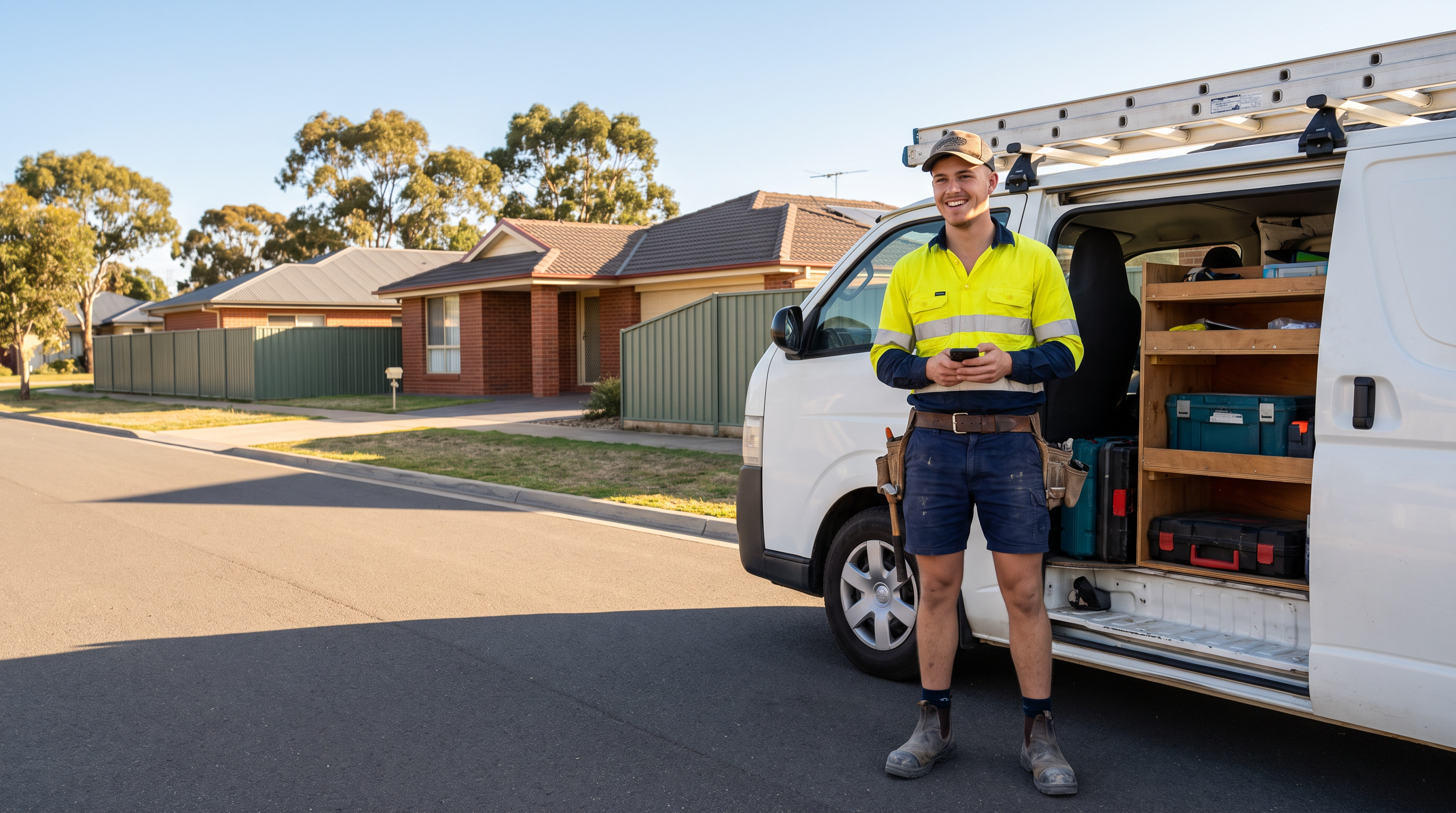
This plumber SEO case study covers six months at a Perth plumbing and gas company, taken straight from Google Search Console. We have not named them. The numbers are unedited, including the one that has not moved.
Most case studies you read are written after the win. This one is written from the middle, because the middle is where nearly every business gives up, and almost nobody shows you what it looks like.
The headline numbers
Twenty-three pages moved up. One moved 75 places. Impressions on some suburb pages grew tenfold. And traffic went from 414 clicks to 431.
If you only look at the last number you would conclude the work failed. That would be the wrong conclusion, and the rest of this post explains why — along with the point at which it would become the right one.
Page by page, what actually moved
Average position across the site went from 43.8 to 31.5. Here are the pages behind that, comparing the six months to July 2026 against the six before it.
| Page | Before | After | Gain |
|---|---|---|---|
| Tap replacement | 112.7 | 37.4 | 75 places |
| About us | 42.0 | 3.7 | 38 places |
| Plumber Wilson | 63.0 | 28.6 | 34 places |
| Plumber Karragullen | 47.4 | 21.9 | 26 places |
| Plumber Riverton | 56.7 | 33.7 | 23 places |
| Plumber Lynwood | 49.6 | 28.5 | 21 places |
| Plumber O’Connor | 48.8 | 31.8 | 17 places |
| Plumber Roleystone | 46.8 | 30.5 | 16 places |
| Home page | 43.8 | 31.5 | 12 places |
| Plumber Medina | 25.1 | 15.3 | 10 places |
| Plumber Leda | 17.4 | 10.4 | 7 places |
The about us page going from 42 to 3.7 is the odd one out, and it is worth understanding why. Nobody searches for a plumber’s about page. It climbed because the site as a whole became easier for Google to read, and the about page was the least contested thing on it. Early gains often show up on pages you do not care about. That is not a failure, it is the first sign the site is being crawled and understood properly.
Why the traffic has not followed yet
Here is the whole answer in one number. The site’s average position is 31.5. That is page four.
Clicks do not rise steadily as you climb. They stay near zero for a very long time and then rise sharply near the top. Moving from position 60 to position 30 is genuinely hard work and earns you almost nothing. Moving from 11 to 5 is easier and changes the business.
Six months of work moved this business from the very bottom of that chart to slightly less bottom. The distance already covered is larger than the distance remaining, but almost all the reward sits in what is left.
The number that says it is working
Impressions. Not the total, which is flat, but where they are landing.
| Suburb page | Impression growth |
|---|---|
| O’Connor | +1,044% |
| Beaconsfield | +964% |
| South Fremantle | +953% |
| Medina | +292% |
| Forrestdale | +253% |
| Piara Waters | +180% |
| Riverton | +171% |
An impression means Google chose to show this business to someone searching in that suburb. Six months ago it mostly did not. Impressions are the signal that arrives before clicks, and clicks are the signal that arrives before phone calls. You get them in that order, never all at once.
One more piece of evidence. A new article about what a gas smell near appliances could mean went from nothing to position 8.8 and 736 impressions in its first months. New content on this site now ranks on page one. Six months ago it did not.
What we actually did
The same six areas we run on every local business, in the same order.
What we got wrong
Too much attention went to Perth-wide terms. Searches like “emergency plumber Perth” get real volume, and this business sits at position 18 for it, which feels close. It is not close. Page one for that term is held by companies with thousands of reviews and years of accumulated links, and the map pack above them is worse again.
Meanwhile the suburb pages are the ones already within reach. Leda sits at 10.4. Medina at 15.3. Myaree at 19.0. Those are one solid push from page one, and a plumber in Leda does not need to beat anyone in the city to win work in Leda.
There is also a straightforward technical problem we should have caught sooner. The site has 111 broken backlinks against 63 working ones — more dead links pointing at it than live ones. Every one of those is authority somebody already gave this business that is currently going nowhere. Redirecting them costs almost nothing.
The honest risk
Ranking improvements that never convert into clicks are still a failure, just a slower one. The question is not whether the graph is going up, it is whether it reaches the part of the graph where clicks live.
So here is the commitment. The measure over the next six months is not average position. It is how many pages reach the top ten, and whether non-brand clicks rise. Right now roughly 35 of every 41 clicks are people typing the company name into Google — customers who already knew about them. That is the number that has to change.
If those two numbers have not moved by the next update, the strategy is wrong and we will say so here.
Work out what page one is worth to you
Open Search Console, find your average position and your monthly impressions, and put them in. This shows the gap between where you are and where the clicks start.
What this plumber SEO case study does not prove
It does not prove the work paid for itself. Six months in, traffic is up four percent, and four percent of a small number is a smaller number. On revenue alone this has not yet been worth what it cost.
It also does not isolate our work from everything else. Competitors move, Google updates, seasons change. Search Console shows what happened, not why.
What it does show is a site moving in one direction across twenty-three pages at once, which rarely happens by accident.
Plumber SEO questions, answered
How long does SEO take for a plumbing business?
Expect rankings to move within three to six months and traffic to follow later. In this case twenty-three pages climbed over six months while clicks rose only four percent, because the pages were still on page three and four. Traffic arrives when pages reach the top ten, not when they start climbing.
Why did my rankings improve but my phone is not ringing?
Because click-through rate is not linear. Position 1 earns roughly 28% of clicks, position 10 about 2.5%, and position 30 around 0.4%. Moving from 50 to 30 is real progress that earns almost nothing. The reward is concentrated in the top five, so the last stretch matters more than everything before it.
Should a plumber target city-wide keywords or suburbs?
Suburbs first, almost always. City-wide terms like “emergency plumber Perth” are held by firms with thousands of reviews and years of links. Suburb searches have less volume but far less competition, higher intent, and you only need to beat the plumbers who also work in that suburb.
What does it mean if most of my clicks are people searching my business name?
It means your website is not yet winning you new customers. In this case about 35 of every 41 clicks were brand searches — people who already knew the business. Brand traffic is worth having, but it is demand you already earned elsewhere. Non-brand clicks are the number that shows SEO is working.
Are impressions worth anything on their own?
Not directly, but they are the earliest reliable sign of progress. An impression means Google decided you were relevant enough to show. On this site, suburb pages gained between 170% and 1,044% more impressions before any clicks appeared. The order is impressions, then clicks, then calls.
If you run a trade business
Open Search Console and look at two things: your average position, and how many of your clicks are people typing your business name. If your position is above 20 and most clicks are brand searches, you are where this business was six months ago. That is a fixable position, but not a fast one.
We work with plumbers, sparkies, locksmiths and other trades across Perth, and we publish the numbers either way. If you want an honest read on where your site actually sits, get in touch — or start with our local SEO service if you want to see how the whole thing fits together.
We publish the other side too. Our law firm SEO case study covers a business twelve months in, where the traffic did arrive — useful for seeing what the far end of this curve looks like.
If you want to see visibility mapped rather than averaged, our local pack case study plots 81 separate Google Maps searches across one business’s catchment — the same business ranked first and outside the top twenty for the same term on the same day.